FcγRIIa-H ADCP Bioassay

Measure Potency and Stability of Biologics that Bind and Activate ADCP through FcγRIIa-H
- Complete format contains everything you need to get started
- Use Core format with customer-defined Ab and target cells
- Also available in cell propagation model (CPM) format

Catalog Number:
Choose a Product
Size
Catalog Number: G9901
Catalog Number: G9991
Catalog Number: G9995
Catalog Number: G9871
Measure Potency and Stability of Biologics that Bind and Activate FcyRIIa-H
Antibody-dependent cell-mediated phagocytosis (ADCP) is an important mechanism of action (MOA) of therapeutic antibodies. In vivo, ADCP can be mediated by monocytes, macrophages, neutrophils and dendritic cells via FcγRIIa, FcγRI and FcγRIIIa. While all three receptors can participate in ADCP, FcγRIIa is believed to be the predominant Fcγ receptor involved in this process.
The FcγRIIa-H ADCP Reporter Bioassay is a biologically relevant MOA-based assay that can be used to measure the potency and stability of antibodies and other biologics that specifically bind and activate FcγRIIa. The assay consists of Jurkat cells stably expressing human FcγRIIa-H (the high-affinity H131 variant) and NFAT-induced luciferase.
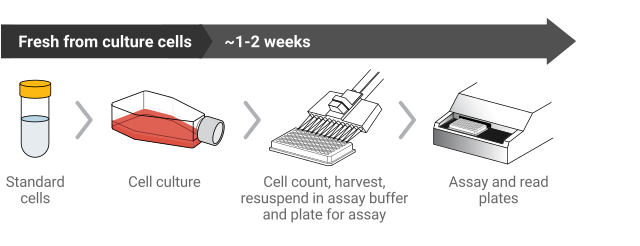
The bioassay workflow is simple and robust, compatible with 96-well and 384-well plate formats, and unlike traditional primary cell-based assays, amenable for use in quality-controlled drug development settings.
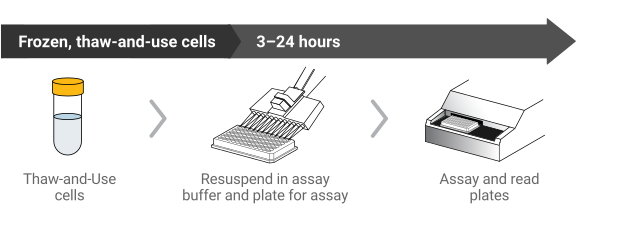
The Workflow
Standardized Reagents Improve Results
- Thaw-and-use cell format provides significant time and labor savings over traditional methods while reducing variability.
- Kit includes all of the required reagents in standardized formats.
- Easily amenable to high-throughput workflows.
The Assay Principle
The Fc Effector Reporter Bioassays use an alternative readout from traditional primary cell based assays: the FcγR and NFAT-mediated activation of luciferase activity in the effector cells. Primary cells are replaced with a Jurkat cell line stably expressing human FcγRIIa H-131and NFAT-induced luciferase.

Luminescent Assay Monitors Fc Effector Activity
Following engagement with the Fc region of a relevant antibody bound to a Target Cell, ADCP Bioassay Effector Cells expressing FcγRIIa-H131 with transduce intracellular signals resulting in NFAT-RE-mediated luciferase activity that can be easily quantified.
Assay Performance Data
Accuracy and Precision are critical to bioassays and the development of new biologics. The ADCP Reporter Bioassays are both accurate and precise and have been prequalified according to ICH guidelines and show the precision, accuracy and linearity required for routine use in potency and stability studies. Accuracy is a measure of how close results are to a target or reference value. Precision is a measure of repeatability.
Accuracy: Measure of ability to replicate a reference or “target” value.
IntraLab Precision: Measure of repeatability from multiple assays of the same homogeneous sample under the same operating conditions over a short time (same analyst; same lab; same day).
Intermediate Precision: Measure of repeatability of multiple assays of the same homogeneous sample with different analysts or equipment or on different days.
Linearity: Ability of the assay to provide measured values that are proportional to the concentration of the sample.

ADCP Reporter Bioassay Shows Precision, Accuracy and Linearity
Raji Target Cells
| Parameter | Results | |
|---|---|---|
| Accuracy | % Expected Relative Potency | % Recovery |
| 50 | 99.1 | |
| 75 | 102.7 | |
| 150 | 105.0 | |
| 200 | 99.1 | |
| Repeatability (% CV) | 100% (Reference) | 6.5 |
| Intermediate Precision (% CV) | 3.5 | |
| Linearity (r2) | 0.997 (50–200% range) | |
| Linearity (y = mx + b) | y = 0.997x + 1.95 | |
|
A 50–200% theoretical relative potency series of the ADCP Control Ab, anti-CD20 (IgG1), was analyzed in triplicate in three independent experiments performed on three days. Luciferase activity was quantified using the Bio-Glo™ Reagent. Data were analyzed and relative potencies calculated after parallelism determination using JMP® software. Data were generated using thaw-and-use cells. |
||
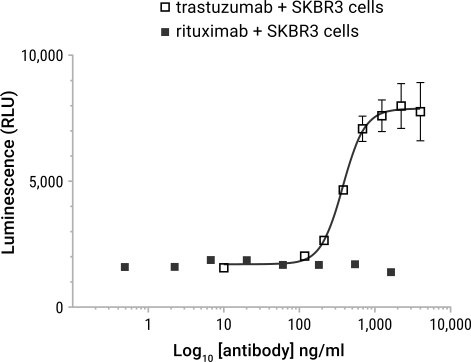
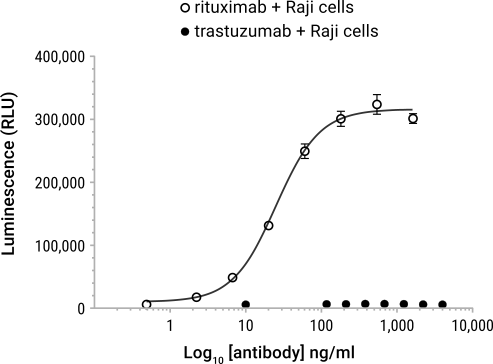
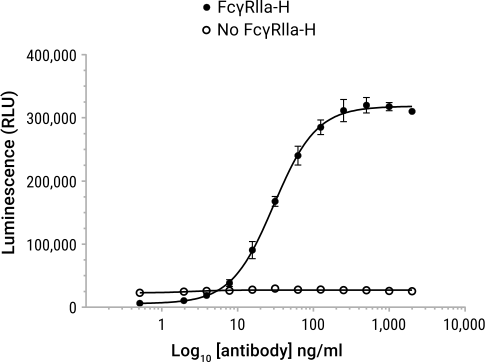
The ADCP Bioassay reflects the MOA and specificity of antibodies designed to bind and activate FcγRIIa-H
Product Format
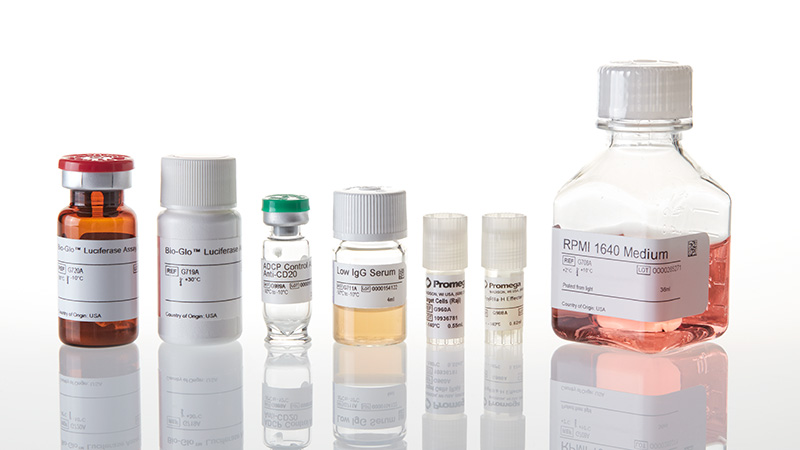
Complete Kit
- Includes FcγRIIa-H Effector Cells, Target Cells (Raji), Control Antibody, Cell Culture Medium and Assay Reagents.
- Recommended for use as a starter kit.
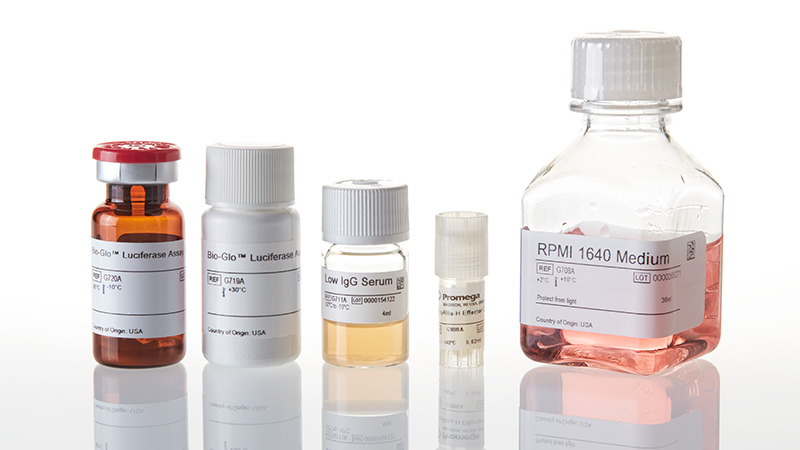
Core Kit
- Includes FcγRIIa-H Effector Cells, Cell Culture Medium and Assay Reagents.
- Recommended for routine use with customer-defined antibody and target cells.
- Available in 1X and 5X sizes.
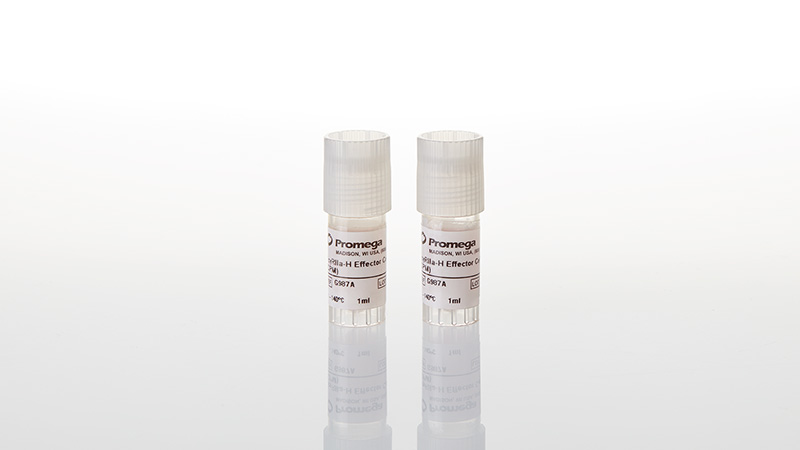
Cell Propagation Model
- Includes FcγRIIa-H Effector Cells (CPM); these are cryopreserved cells that can be thawed, propagated and banked for long-term use.
- Use to measure the potency and stability of antibodies and other biologics with Fc domains that specifically bind and activate FcγRIIa.
Specifications
Catalog Number:
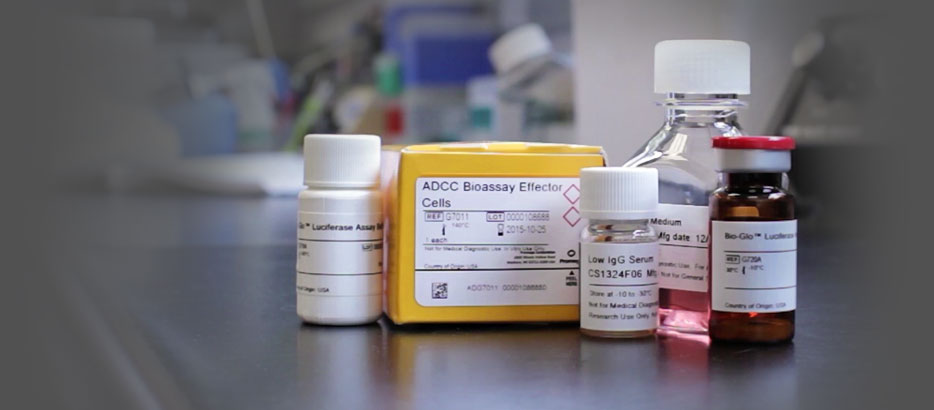
What's in the box?
| Item | Part # | Size |
|---|---|---|
FcγRIIa-H Effector Cells |
G988A | 1 × 0.62ml |
Target Cells (Raji) |
G960A | 1 × 0.55ml |
ADCP Control Ab, Anti-CD20 |
G989A | 1 × 2.5μg |
Low IgG Serum |
G711A | 1 × 4ml |
RPMI 1640 Medium |
G708A | 1 × 36ml |
Bio-Glo™ Luciferase Assay Buffer |
G719A | 1 × 10ml |
Bio-Glo™ Luciferase Assay Substrate |
G720A | 1 × 1 vial |
SDS
Search for SDSCertificate of Analysis
Use Restrictions
Not For Medical Diagnostic Use.Storage Conditions
Please see the Protocol for detailed storage conditions.
General Bioassay (using Bio-Glo™ Luciferase Assay System) Limited Use Label License
NOT FOR MEDICAL DIAGNOSTIC USE. FOR IN VITRO USE ONLY. BY USE OF THIS PRODUCT, RECIPIENT AGREES TO BE BOUND BY THE TERMS OF THIS LIMITED USE STATEMENT. If the recipient is not willing to accept the conditions of this limited use statement, and the product is unused, Promega will accept return of the unused product and provide the recipient with a full refund.
This product may not be further sold or transferred by the recipient and may be used only by the recipient, and then only for (1) research use, (2) discovery, development and monitoring of biologic drugs and vaccines, (3) quality assurance testing of biologic drugs and vaccines, and (4) product release assays for biologic drugs and vaccines. No other commercial use is allowed. "Commercial use” means any and all uses of this product by recipient for monetary or other consideration, including providing a service, information or data to unaffiliated third parties, and resale of this product for any use. Recipient has no right to propagate, modify, derivatize, genetically engineer or otherwise create variations of the cells or genes stably transfected within the cells. In addition, recipient must use Bio-Glo™ Luciferase Assay System purchased from Promega Corporation for all luminescence assays using this product or contact Promega to obtain a license for use of this product with reagents other than Promega’s. PROMEGA MAKES NO REPRESENTATIONS OR WARRANTIES OF ANY KIND, EITHER EXPRESSED OR IMPLIED, INCLUDING AS TO MERCHANTABILITY OR FITNESS FOR A PARTICULAR PURPOSE WITH REGARDS TO THIS PRODUCT. The terms of this agreement shall be governed under the laws of the State of Wisconsin, USA.
Licensed from Lonza Cologne GmbH under U.S. Pat. Nos. 7,700,357, 8,192,990 and 8,003,389, European Pat. Nos. 1297119, 1522587, 1607484 and 1741778 and other pending and issued patents.
What's in the box?
| Item | Part # | Size |
|---|---|---|
FcγRIIa-H Effector Cells |
G988A | 1 × 0.62ml |
Low IgG Serum |
G711A | 1 × 4ml |
RPMI 1640 Medium |
G708A | 1 × 36ml |
Bio-Glo™ Luciferase Assay Buffer |
G719A | 1 × 10ml |
Bio-Glo™ Luciferase Assay Substrate |
G720A | 1 × 1 vial |
SDS
Search for SDSCertificate of Analysis
Use Restrictions
Not For Medical Diagnostic Use.Storage Conditions
Please see the Protocol for detailed storage conditions.
General Bioassay (using Bio-Glo™ Luciferase Assay System) Limited Use Label License
NOT FOR MEDICAL DIAGNOSTIC USE. FOR IN VITRO USE ONLY. BY USE OF THIS PRODUCT, RECIPIENT AGREES TO BE BOUND BY THE TERMS OF THIS LIMITED USE STATEMENT. If the recipient is not willing to accept the conditions of this limited use statement, and the product is unused, Promega will accept return of the unused product and provide the recipient with a full refund.
This product may not be further sold or transferred by the recipient and may be used only by the recipient, and then only for (1) research use, (2) discovery, development and monitoring of biologic drugs and vaccines, (3) quality assurance testing of biologic drugs and vaccines, and (4) product release assays for biologic drugs and vaccines. No other commercial use is allowed. "Commercial use” means any and all uses of this product by recipient for monetary or other consideration, including providing a service, information or data to unaffiliated third parties, and resale of this product for any use. Recipient has no right to propagate, modify, derivatize, genetically engineer or otherwise create variations of the cells or genes stably transfected within the cells. In addition, recipient must use Bio-Glo™ Luciferase Assay System purchased from Promega Corporation for all luminescence assays using this product or contact Promega to obtain a license for use of this product with reagents other than Promega’s. PROMEGA MAKES NO REPRESENTATIONS OR WARRANTIES OF ANY KIND, EITHER EXPRESSED OR IMPLIED, INCLUDING AS TO MERCHANTABILITY OR FITNESS FOR A PARTICULAR PURPOSE WITH REGARDS TO THIS PRODUCT. The terms of this agreement shall be governed under the laws of the State of Wisconsin, USA.
Licensed from Lonza Cologne GmbH under U.S. Pat. Nos. 7,700,357, 8,192,990 and 8,003,389, European Pat. Nos. 1297119, 1522587, 1607484 and 1741778 and other pending and issued patents.
What's in the box?
| Item | Part # | Size |
|---|---|---|
FcγRIIa-H Effector Cells |
G988A | 5 × 0.62ml |
Low IgG Serum |
G711A | 5 × 4ml |
RPMI 1640 Medium |
G708A | 5 × 36ml |
Bio-Glo™ Luciferase Assay Buffer |
G719A | 5 × 10ml |
Bio-Glo™ Luciferase Assay Substrate |
G720A | 5 × 1 vial |
SDS
Search for SDSCertificate of Analysis
Use Restrictions
Not For Medical Diagnostic Use.Storage Conditions
Please see the Protocol for detailed storage conditions.
General Bioassay (using Bio-Glo™ Luciferase Assay System) Limited Use Label License
NOT FOR MEDICAL DIAGNOSTIC USE. FOR IN VITRO USE ONLY. BY USE OF THIS PRODUCT, RECIPIENT AGREES TO BE BOUND BY THE TERMS OF THIS LIMITED USE STATEMENT. If the recipient is not willing to accept the conditions of this limited use statement, and the product is unused, Promega will accept return of the unused product and provide the recipient with a full refund.
This product may not be further sold or transferred by the recipient and may be used only by the recipient, and then only for (1) research use, (2) discovery, development and monitoring of biologic drugs and vaccines, (3) quality assurance testing of biologic drugs and vaccines, and (4) product release assays for biologic drugs and vaccines. No other commercial use is allowed. "Commercial use” means any and all uses of this product by recipient for monetary or other consideration, including providing a service, information or data to unaffiliated third parties, and resale of this product for any use. Recipient has no right to propagate, modify, derivatize, genetically engineer or otherwise create variations of the cells or genes stably transfected within the cells. In addition, recipient must use Bio-Glo™ Luciferase Assay System purchased from Promega Corporation for all luminescence assays using this product or contact Promega to obtain a license for use of this product with reagents other than Promega’s. PROMEGA MAKES NO REPRESENTATIONS OR WARRANTIES OF ANY KIND, EITHER EXPRESSED OR IMPLIED, INCLUDING AS TO MERCHANTABILITY OR FITNESS FOR A PARTICULAR PURPOSE WITH REGARDS TO THIS PRODUCT. The terms of this agreement shall be governed under the laws of the State of Wisconsin, USA.
Licensed from Lonza Cologne GmbH under U.S. Pat. Nos. 7,700,357, 8,192,990 and 8,003,389, European Pat. Nos. 1297119, 1522587, 1607484 and 1741778 and other pending and issued patents.
What's in the box?
| Item | Part # | Size |
|---|---|---|
FcγRIIa-H Effector Cells (CPM) |
G987A | 2 × 1ml |
SDS
Search for SDSCertificate of Analysis
Use Restrictions
Not For Medical Diagnostic Use.Storage Conditions
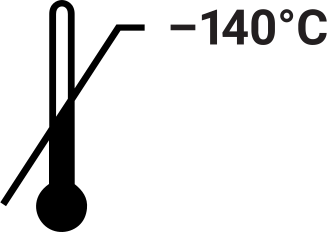
Please see the Protocol for detailed storage conditions.
General Bioassay Cell-Propagation Model (using Bio-Glo™ Luciferase Assay System) Limited Use Label License
NOT FOR MEDICAL DIAGNOSTIC USE. FOR IN VITRO USE ONLY. BY USE OF THIS PRODUCT, RECIPIENT AGREES TO BE BOUND BY THE TERMS OF THIS LIMITED USE STATEMENT. If the recipient is not willing to accept the conditions of this limited use statement, and the product is unused, Promega will accept return of the unused product and provide the recipient with a full refund.
This product may not be further sold or transferred by the recipient and may be used only by the recipient, and then only for (1) research use, (2) discovery, development and monitoring of biologic drugs and vaccines, (3) quality assurance testing of biologic drugs and vaccines, and (4) product release assays for biologic drugs and vaccines. No other commercial use is allowed. "Commercial use" means any and all uses of this product by recipient for monetary or other consideration, including providing a service, information or data to unaffiliated third parties, and resale of this product for any use. Recipient has no right to modify, derivatize, genetically engineer or otherwise create variations of the cells or genes stably transfected within the cells except that recipient may propagate and store the cells for long-term use. In addition, recipient must use Bio-Glo™ Luciferase Assay System purchased from Promega Corporation for all luminescence assays using this product or contact Promega to obtain a license for use of this product with reagents other than Promega's. PROMEGA MAKES NO REPRESENTATIONS OR WARRANTIES OF ANY KIND, EITHER EXPRESSED OR IMPLIED, INCLUDING AS TO MERCHANTABILITY OR FITNESS FOR A PARTICULAR PURPOSE WITH REGARDS TO THIS PRODUCT. The terms of this agreement shall be governed under the laws of the State of Wisconsin, USA.
Licensed from Lonza Cologne GmbH under U.S. Pat. Nos. 7,700,357, 8,192,990 and 8,003,389, European Pat. Nos. 1297119, 1522587, 1607484 and 1741778 and other pending and issued patents.
Resources
No related resources available
Related Products
Similar Products
ADCC Reporter Bioassay, F Variant
Characterize Fc effector activity of antibodies mediating ADCC through the low-affinity human FcγRIIIa-F receptor.
G9790, G9798, G9302
ADCC Reporter Bioassay, V Variant
Measure potency and stability of antibodies mediating ADCC through the high-affinity human FcγRIIIa-V receptor.
G7015, G7010, G7016, G7018, G7102, GA1130
PD-1/PD-L1 Blockade Bioassay
Measure the ability of biologics to block immune checkpoint signals
J1250, J1255, J1252, J1191, J1195, J1201
Lumit® FcγR Binding Immunoassays
Novel homogeneous competition assays to measure the interaction between human Fc receptors and antibodies or Fc fusion proteins.
W7030, W7031, W7040, W7041, W7050, W7051, W7060, W7061, W7070, W7071, W7080, W7081
Frequently Used With
Bio-Glo™ Luciferase Assay System
Bioluminescent detection reagent qualified for use with bioassays that utilize firefly luciferase.
G7940, G7941
GloMax® Discover System
High-performance microplate reader for detecting luminescence, fluorescence and absorbance.
GM3000
pHAb Reactive Dyes
Measure antibody internalization in real time with pH-sensitive fluorescent dyes.
G9841, G9831, G9835, G9845